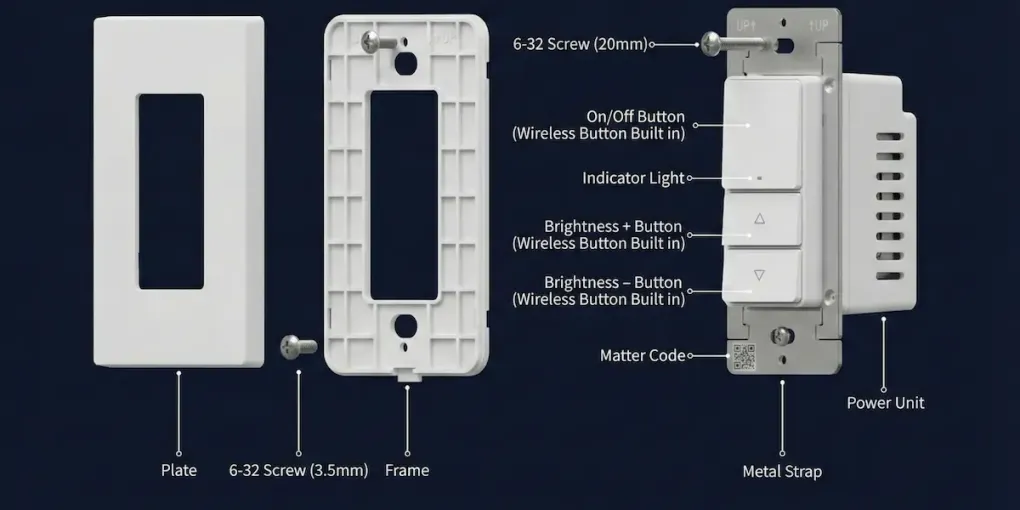
Aqara is aggressively expanding its Matter over Thread lineup. Today, we are taking a deep dive into the engineering of the Aqara Dimmer Switch H2 US (Model: WS-K05E) via its FCC filing (ID: 2AKIT-WSK05E).
Unlike a standard on/off switch that uses a mechanical relay, a Dimmer is a more complex beast. It has to regulate voltage precisely to fade your lights smoothly without flickering.
As an embedded engineer, I dug into the FCC documents to see how Aqara designed the internal architecture of their next-gen dimmer. Here is my analysis.
Table of Contents
- The Teardown: What’s Inside?
- Engineering Deep Dive
- The “Matter” Factor: Why the Neutral Wire Matters
- Verdict: Engineer’s Take
The Teardown: What’s Inside?
The US electrical gang box is a hostile environment—cramped and hot. A dimmer adds to this challenge because the act of dimming (chopping the AC sine wave) naturally generates heat as a byproduct.
While the internal PCB photos are currently confidential, the assembly diagram in the User Manual gives us clear engineering clues. The deep, enclosed “Power Unit” structure suggests a dense Solid-State Switching design rather than the bulky mechanical relays found in standard switches. This design is tailored for precise control of dimmable loads (LEDs, CFLs, Incandescent).
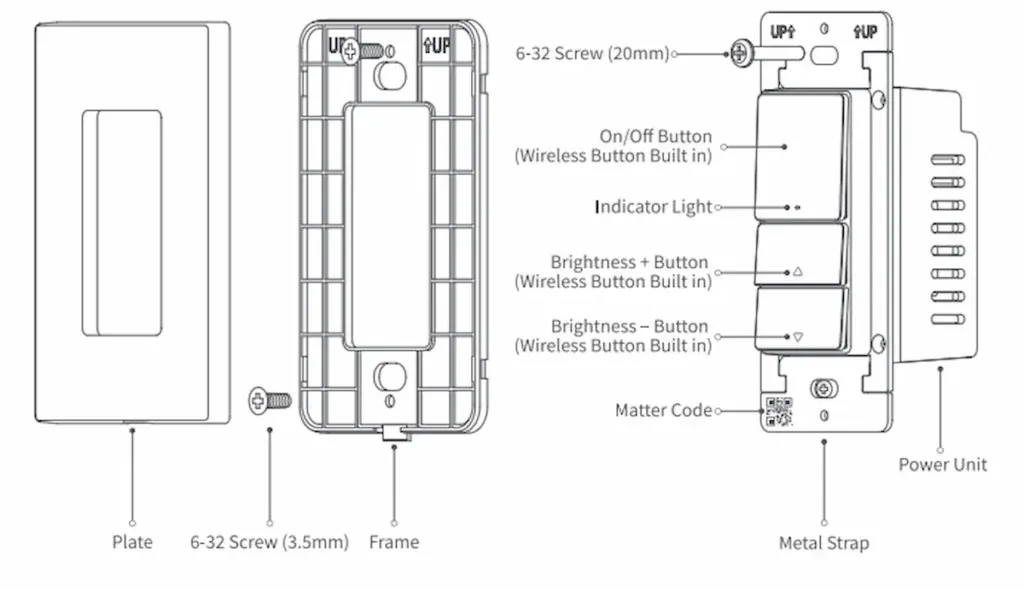
Figure 1: Assembly diagram showing the deep Power Unit and Metal Strap, likely serving as a heatsink. (Source: Aqara User Manual via FCC ID 2AKIT-WSK05E)
Technical Specifications (deduced)
| Feature | Specification | Notes |
|---|---|---|
| Model | WS-K05E | US Single Rocker Form Factor |
| Function | Smart Dimmer | 1% - 100% Brightness Control |
| Protocols | Matter over Thread, Zigbee 3.0 | Acts as a Thread Router |
| Power | 120V AC | Neutral Wire Required (Likely) |
| Main SoC | Multi-protocol MCU | SiLabs MG24 or NXP K32W series |
Engineering Deep Dive
1. Solid-State Dimming (No Clicks!)
The biggest engineering difference here is the absence of the mechanical “Click” sound. This device relies on Solid-State Switching (likely MOSFETs) to perform Phase-Cut Dimming. Although we cannot see the exact circuit without opening the unit, the device’s ability to support modern LED loads suggests sophisticated Leading-edge and Trailing-edge dimming logic. This is crucial for preventing the dreaded “ghosting” or “flickering” issues common with cheap dimmers.
2. Thermal Management (The Metal Strap)
Since semiconductor dimming generates heat, thermal dissipation is the #1 priority. The assembly diagram in the user manual clearly highlights a large “Metal Strap” surrounding the frame. In a dense dimmer design, this strap often serves a dual purpose: structural support and acting as a crucial Heatsink. Efficient heat dissipation through this strap is vital to prevent thermal throttling inside the tight gang box.
3. The “Thread” Backbone
The defining feature of the H2 series is connectivity. By adopting Matter over Thread, this dimmer becomes a core part of your smart home infrastructure. With a constant AC power source, this switch will act as a Thread Router, extending the mesh network for your battery-powered sensors. For this to work reliably, the internal antenna must be positioned to broadcast RF signals out of the metal/plastic wall box efficiently, overcoming the electrical noise generated by the dimming circuit.
The “Matter” Factor: Why the Neutral Wire Matters
According to the wiring diagrams in the user manual, it is confirmed that this device requires a Neutral Wire.
Why? Because of Matter over Thread. Unlike older Zigbee dimmers that could sometimes run on “leakage current” (No-Neutral), a device designed to be a rock-solid Thread Router needs a stable, constant power budget. It acts as the backbone of your smart home network, repeating signals for other devices.
Furthermore, for a Dimmer, having a neutral wire is engineeringly superior. It allows the device to drive low-power LED bulbs without the notorious “ghosting” (glowing when off) or flickering issues that plague no-neutral dimmers. Aqara chose stability over backward compatibility here.
Verdict: Engineer’s Take
The Aqara Dimmer Switch H2 (WS-K05E) looks like a solid evolution for users who want precise lighting control without leaving the Matter ecosystem.
Pros:
-
Native Matter Support: Future-proof connectivity.
-
Smart Load Compatibility: Designed for modern LEDs.
-
Silent Operation: No mechanical relay clicking sound.
Cons:
-
Wiring: Requires a Neutral wire, limiting retrofits in older homes.
-
Heat: Dimmers always run warmer than switches; proper installation box space is needed.
Disclaimer: This analysis is based on public FCC documents (ID: 2AKIT-WSK05E) and user manuals. I have not physically tested this unreleased device. All opinions are my own based on engineering experience.