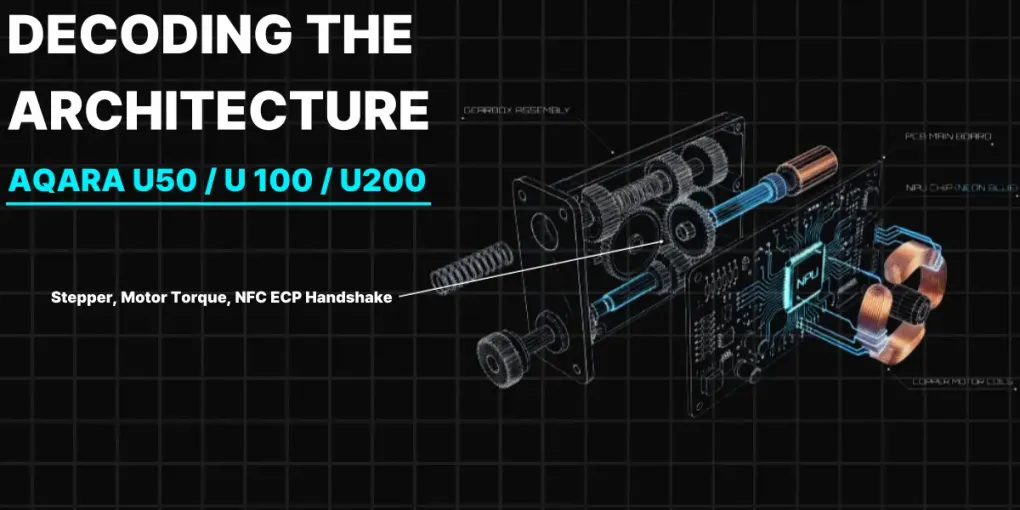
From a hardware engineer’s perspective, a smart lock is not merely an IoT device—it is the frontline where physical friction, network topology, and encryption protocols collide. Consumers often evaluate these devices based on mobile app UI or unlocking methods, but the true engineering challenge lies beneath the chassis.
Balancing the raw torque required to push a physical deadbolt against the Round-Trip Time (RTT) latency of a wireless mesh network is notoriously difficult. Aqara’s recent lineup—the U50, U100, and U200—operates under the same brand umbrella but showcases fundamentally different philosophies in mechanical architecture, Bill of Materials (BOM) optimization, and communication standards. Here is a teardown of how these three architectures handle the physics of security and the nuances of data routing.
Hardware Tiering and BOM Optimization: U100 vs U50
When a manufacturer decides to diversify a product line, cutting an entirely new PCB requires massive R&D expenditure and assembly line retooling. Instead, hardware engineers execute what is known as BOM (Bill of Materials) optimization.
The U100 features a flagship architecture, packing a biometric fingerprint DSP alongside Apple HomeKey (NFC), keypad, and physical key mechanisms. The U50 shares the exact same mechanical chassis, stepper motor, and gearbox as the U100, but strategically strips out the biometric sensor module to drastically lower the production cost.
From a manufacturing standpoint, this is a brilliant modular design. By maintaining the same motherboard footprint and pin map while leaving the expensive biometric components unpopulated, they maximize assembly line efficiency. Crucially, they retained the core security asset—the NXP-based NFC chipset—ensuring that the zero cold boot latency experienced with Apple HomeKey remains intact. It is a textbook example of engineering tuning: stripping away the hardware fluff while preserving the immediate responsiveness that users actually value.
Engineering Specification Analysis
| Feature | Aqara U50 (BOM Optimized) | Aqara U100 (Flagship Deadbolt) | Aqara U200 (Thread Retrofit) |
|---|---|---|---|
| Price (MSRP) | ~$150 | ~$189 - $229 | ~$270 |
| Outer Dimensions | 135.8 × 74.8 × 88.4 mm | 134.2 × 73.2 × 81.4 mm | Keypad: 42.7 × 33 × 146 mm |
| Inner Dimensions | (Shared with outer panel) | 140.2 × 76.2 × 29 mm | Lock: 62.3 × 60.6 × 152.5 mm |
| Protocols | Zigbee 3.0, Bluetooth 5.0, NFC | Zigbee 3.0, Bluetooth 5.0, NFC | Matter over Thread, Bluetooth 5.1, NFC |
| Apple HomeKey | Yes (Native Support) | Yes (Native Support) | Yes (Native Support) |
| Power Supply | 4 × AA (LR6) Batteries USB-C (5V) Emergency | 4 × AA (LR6) Batteries USB-C (5V) Emergency | Lock: 7.4V 2000mAh Li-ion Battery Keypad: 4 × AAA or 12-24V Hardwired |
| Battery Life | Up to 6 months | Up to 8 months | Up to 6 months (Rechargeable) |
| IP Rating | IPX5 / IP65 (Keypad) | IP65 (Keypad) | IPX5 (Keypad) |
| Biometrics | No (Module Removed) | Yes (Up to 50 fingerprints) | Yes (On external Keypad) |
| Quiet Unlock | Yes (Software Motor Control) | Yes (Software Motor Control) | Yes (Hardware Quiet Mode) |
Engineering Note: While the U50 and U100 share the same direct-drive gearbox, the U200 utilizes a massive 7.4V Li-ion battery pack as its primary power source to overcome the heavy physical resistance of existing lock cylinders.
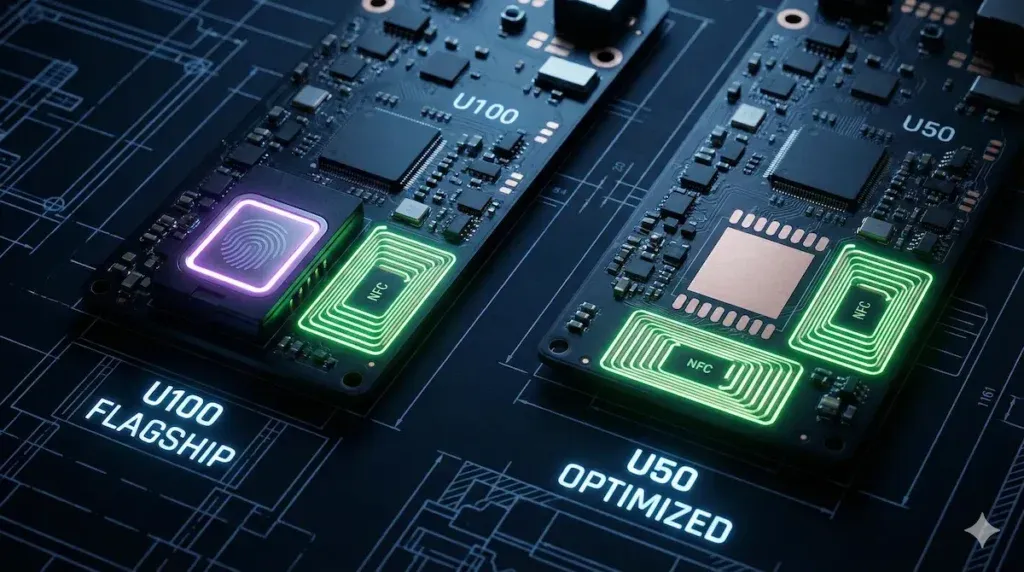
By removing the high-cost biometric module (purple) while retaining the critical NXP NFC chipset (green), the U50 achieves aggressive pricing without sacrificing Apple HomeKey performance.
The Physical Limits of Mechanical Architecture: Direct Drive vs. Retrofit
The reliability of a smart lock fundamentally depends on motor control. The U50 and U100 utilize a ‘Direct Drive’ architecture, meaning they completely replace the door’s existing deadbolt. Because the physical friction coefficient of the provided deadbolt is calculated during the design phase, the firmware can supply the exact optimal duty cycle to the stepper motor. If the door is jammed, the overcurrent protection circuit triggers instantly, preventing motor burnout.
Conversely, the U200 is a retrofit design built to turn existing keys or thumbturns. It must overcome the unknown, highly variable physical resistance of hundreds of different cylinder standards globally—from stiff European multipoint locks to smooth North American deadbolts. To combat this mechanical variance, the U200 employs a highly sophisticated torque calibration algorithm. During setup, the motor’s encoder learns and maps the precise RPM and resistance curve required for your specific door, saving it to memory to prevent battery drain and gear stripping.
This baseline data is written to memory, allowing the lock to apply dynamic torque to overcome friction spikes without prematurely stripping the internal gears or draining the 7.4V battery pack. For a deeper understanding of how this calibration interacts with the physical world, check out our [engineering analysis of the U200’s Li-Ion power delivery and gyroscope mechanisms].
Network Topology Shift: Zigbee 3.0 vs Matter over Thread
Beyond the physical chassis, how the device routes data dictates its real-world speed.
The U50 and U100 rely on the highly reliable Zigbee 3.0 protocol. While Zigbee (based on IEEE 802.15.4) is excellent for low-power devices, it is not native to the Internet Protocol (IP). Therefore, it requires a proprietary Aqara Hub to translate data packets before they reach your Wi-Fi router. (Our [FCC teardown of the Aqara Hub M3] reveals exactly how this edge computing and translation process occurs at the hardware level). This bridging process inevitably introduces micro-latency and packet overhead.
The U200 natively adopts Matter over Thread. Utilizing an IPv6-based mesh network topology, it entirely bypasses the need for a vendor-locked hub. If you have a constantly powered Thread Border Router (such as an Apple HomePod or a modern smart plug) in your home, the U200 immediately joins as a local node. This robust mesh significantly reduces the communication discovery time when the lock wakes from sleep mode, extending battery life while offering unparalleled routing speed.
Data Sovereignty and Cryptographic Handshakes
Regardless of the routing protocol, all three models support Apple HomeKey. This is not just a convenience feature; it represents the highest tier of data sovereignty. Cryptographic keys stored in the Secure Element of your iPhone or Apple Watch perform localized handshakes via the NFC ECP (Enhanced Contactless Polling) protocol. This authentication occurs strictly within physical proximity and completely bypasses external cloud servers, isolating your home’s physical access from potential remote server outages or cloud-based attacks.
Which Architecture Fits Your Door?
Reading a hardware spec sheet is very different from experiencing the mechanical actuation on a real door.
Aqara U100: Ideal for homeowners heavily invested in the Zigbee ecosystem who demand an independent, top-tier physical security architecture. Because it directly drives its own deadbolt, the mechanical failure rate is the lowest, and response times are highly consistent.
Aqara U50: The ultimate ROI for rationalists or Airbnb hosts. By cleverly stripping out the expensive biometric module, it offers the exact same mechanical reliability and Apple HomeKey speeds as the flagship, but at a heavily optimized BOM price point.
Aqara U200: The definitive solution for renters or those with non-standard European/Asian cylinders. It overcomes the physical friction challenges of retrofit designs through precise torque calibration and a massive Li-ion battery pack. (If you are debating between retrofit architectures, see our [head-to-head mechanical teardown of the Aqara U200 vs. SwitchBot Lock Pro]). Furthermore, it offers the most advanced Matter over Thread communication architecture for engineers looking to build a modern, hub-free IPv6 mesh network.