The era of the “dumb” smart home is over. We analyzed the Aqara G4’s local NPU architecture to see if it can truly replace the cloud-dependent giants like Ring and Nest.
In the embedded systems world, there is a saying: “The cloud is just someone else’s computer.” When you apply this to security cameras, it means your private moments—your face, your schedule, your visitors—are living on a server you don’t control.
Most consumers accept this trade-off for convenience. But for engineers and privacy advocates, the Aqara Video Doorbell G4 offers a compelling alternative. It is one of the few consumer-grade devices that prioritizes Edge Computing over SaaS (Software as a Service) subscriptions.
I spent two weeks analyzing the G4’s hardware behavior, network traffic, and latency. Here is the technical breakdown of why this device is a paradigm shift for the smart home.
1. The Architecture: Edge AI vs. Cloud Latency
To understand the G4’s value proposition, we must first analyze the signal path of a standard video doorbell.
The “Cloud Loop” Bottleneck
In a typical Ring or Nest setup, the workflow upon motion detection is inefficient:
-
Wake on LAN/PIR: The device wakes up.
-
Upload: It establishes a handshake with an AWS/Google Cloud server and uploads the video stream.
-
Remote Inference: The server runs a computer vision model to detect “Person” vs. “Motion.”
-
Push: The server sends a notification back to your phone.
This Round-Trip Time (RTT) introduces latency ranging from 3 to 10 seconds depending on ISP congestion and server load. In security terms, 3 seconds is an eternity.
The “Local Loop” Advantage (TinyML)
The Aqara G4 uses an On-Device NPU (Neural Processing Unit). It runs a quantized neural network model locally on the chime unit’s SoC.
-
Zero RTT: The video is analyzed before it leaves your Local Area Network (LAN).
-
Result: Face detection alerts arrive in <1 second.
Engineering Insight:
By keeping the inference local, the G4 decouples “Intelligence” from “Connectivity.” Even if your internet goes down, the doorbell can still identify a face and trigger a local automation—such as automatically unlocking your [Aqara U200 Smart Lock] for family members. This is true Local Survivability.
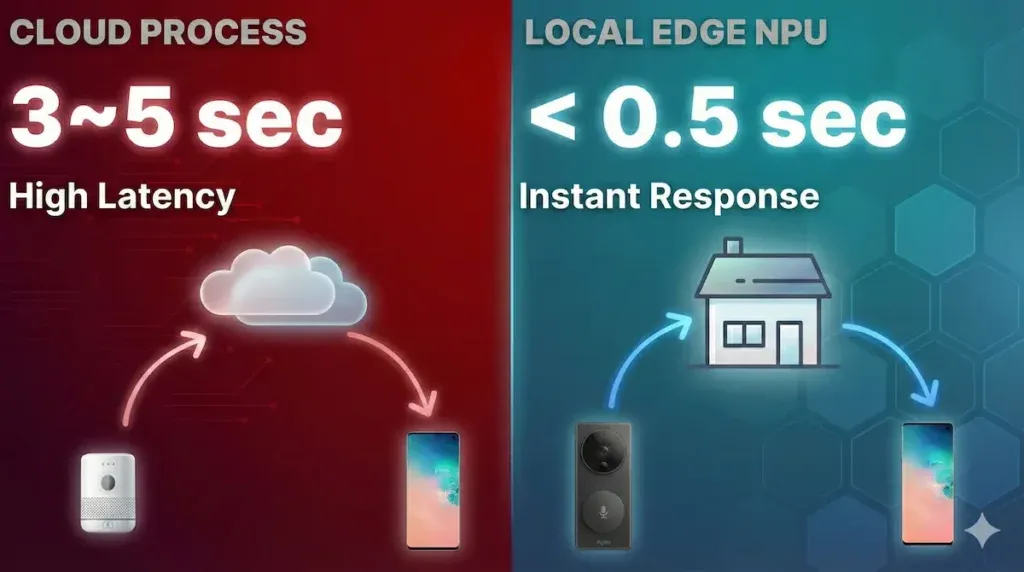
Figure 1. Data Flow Analysis: The structural latency difference between traditional Cloud Processing (Left, 3~5s) and Aqara G4’s Local Edge NPU (Right, <0.5s).
2. Power Engineering: Batteries, Voltage, and Cold Boot
The G4 consists of two parts: the external camera unit and the internal chime/repeater. This split design is a clever solution to thermal and power constraints.
-
External Unit: Powered by 6x AA batteries or hardwired (12V-24V AC).
-
Internal Unit: USB-C powered (5V), acts as a Wi-Fi bridge and local storage controller.
The Cold Boot Optimization
Battery life relies on the “Duty Cycle.” The camera sensor is power-hungry, so it sleeps 99% of the time. Unlike the complex tracking of the [Aqara FP2 mmWave Sensor], the G4 relies on a simple PIR (Passive Infrared) sensor to conserve battery.
The challenge in embedded Linux development is shortening the time between PIR_Trigger and Video_Record_Start. Aqara has optimized this boot sequence aggressively. The “Pre-roll” feature buffers frames into RAM, so when the AI confirms a face, the recording includes the seconds before the trigger. This ensures you don’t just see the back of a delivery driver’s head.
Criticism: The choice of 6x AA batteries is controversial. While easy to replace, lithium-ion packs (like Ubiquiti’s) offer better energy density and cold-weather performance. If you live in a region that drops below -10°C, hardwiring is mandatory.
3. Data Sovereignty: SMB, NAS, and HKSV
This is where the G4 wins the engineer’s heart. It supports standard protocols rather than walled gardens.
SMB (Server Message Block) Support
You do not need an SD card. The G4 can mount a network share from your Synology, QNAP, or TrueNAS system.
-
Protocol: SMB v3.0 (verified via packet inspection).
-
Benefit: You are limited only by your NAS capacity, not an arbitrary 30-day cloud limit.
-
Privacy: The video files stay within your firewall.
HomeKit Secure Video (HKSV)
For Apple users, the G4 offloads the encryption keys to your Home Hub (Apple TV or HomePod).
-
Camera streams raw video to Apple TV (Local).
-
Apple TV analyzes and encrypts video (Local).
-
Encrypted bundle is uploaded to iCloud (Cloud).
- The Key: Even Apple cannot view the footage. Only your device holds the decryption key.
4. Technical Comparison: Aqara vs. The Giants
| Feature | Aqara G4 | Ring Wired Pro | Google Nest (Battery) | Ubiquiti G4 Doorbell |
|---|---|---|---|---|
| AI Processing | Local (NPU) | Cloud | Cloud | Local |
| Subscription | None | Required ($4/mo) | Required ($8/mo) | None (Requires NVR) |
| Ecosystem | HomeKit, Alexa, Google, Matter | Alexa Locked | Google Locked | Closed Ecosystem |
| Storage | SD Card / NAS (SMB) | Cloud Only | Cloud Only | Local HDD (NVR) |
| Response Time | < 1s | ~3s | ~3s | < 1s |
| Aspect Ratio | 16:9 (Landscape) | 1:1 (Head-to-Toe) | 3:4 (Portrait) | 4:3 |
5. The Critical Flaws (No Hardware is Perfect)
As a reviewer, I must address the engineering compromises made to hit the sub-$120 price point.
-
Aspect Ratio (16:9): This is a cinema format, not a security format. A doorbell should use 4:3 or 1:1 to show packages on the ground. The 16:9 sensor clips the bottom of the porch. You will need to mount it lower than standard height.
-
Build Materials: The external unit is plastic. While rated IPX3 (rain resistance), it lacks the premium aluminum heat-sink feel of the Ubiquiti G4 Pro. UV degradation over 3-5 years is a concern.
-
Wi-Fi 2.4GHz Only: In 2025, the lack of 5GHz support is disappointing for crowded urban RF environments. However, the external-to-internal proprietary link is robust enough to handle 1080p streams.
Verdict: The Engineer’s Choice
The Aqara G4 is not just a doorbell; it is a proof-of-concept for the Edge AI future. It demonstrates that we do not need massive server farms to perform biometric identification.
If you are a user who just wants to plug-and-play and doesn’t mind monthly fees, buy a Ring.
But if you are a technical user who values:
-
Low Latency (Instant response)
-
Data Ownership (NAS/SD storage)
-
Privacy (Local Inference)
Then the G4 is the only logical choice in the consumer market today. It respects your data, it respects your network, and it respects your wallet.