
As an R&D Director dealing with embedded systems daily, I have a love-hate relationship with Smart Home gear. I love the convenience, but I hate the instability.
We’ve all been there: You open your home app, and half your devices show “No Response.” It’s usually because cheap Wi-Fi chips in budget plugs are fighting for bandwidth on your overcrowded 2.4GHz network.
That is why I turned my attention to the Eve Energy (Matter over Thread edition). I didn’t crack this one open. Instead, I treated it as a “Black Box” to analyze what matters most: Connectivity Latency, Protocol Stability, and Data Granularity.
Is the “Matter over Thread” hype real? Or is it just marketing fluff to sell expensive hardware? Here is my analysis.
Connectivity: Why “Thread” is a Game Changer
If you are an engineer, think of standard Wi-Fi smart plugs as a “Hub-and-Spoke” topology. Every device must talk directly to your router. If your router is behind a concrete wall, the connection drops.
The Thread Mesh Advantage
Eve Energy uses Thread, which creates a Mesh Network.
-
Why it holds up at range: a Thread device does not have to reach the router on its own. It hands traffic to the nearest mains-powered node on the mesh, which relays onward.
-
The consequence: the “Wi-Fi dead zone” stops being the deciding factor, because coverage comes from the mesh rather than from one access point.
Why? Because Thread devices talk to each other, not just the router. The Eve Energy acts as a Thread Border Router (or node), extending the signal for other devices. From a network architecture perspective, this self-healing capability is the only scalable way to build a reliable smart home.
Where the Latency Actually Comes From
The gap between a generic $10 Tuya Wi-Fi plug and the Eve Energy is not a matter of radio speed. It is a matter of how far the command has to travel.
-
Wi-Fi plug: the command leaves your house, reaches a vendor cloud region, and comes back. The delay is whatever the public internet and that vendor’s backend happen to be doing at the time — which is why it is inconsistent rather than merely slow.
-
Eve Energy (Thread): the command stays on the local mesh. There is no cloud round-trip in the path at all, so the variable component is simply absent.
-
Verdict: For local control, Thread’s low latency is superior because it doesn’t rely on an external cloud server to process a simple “On/Off” command.
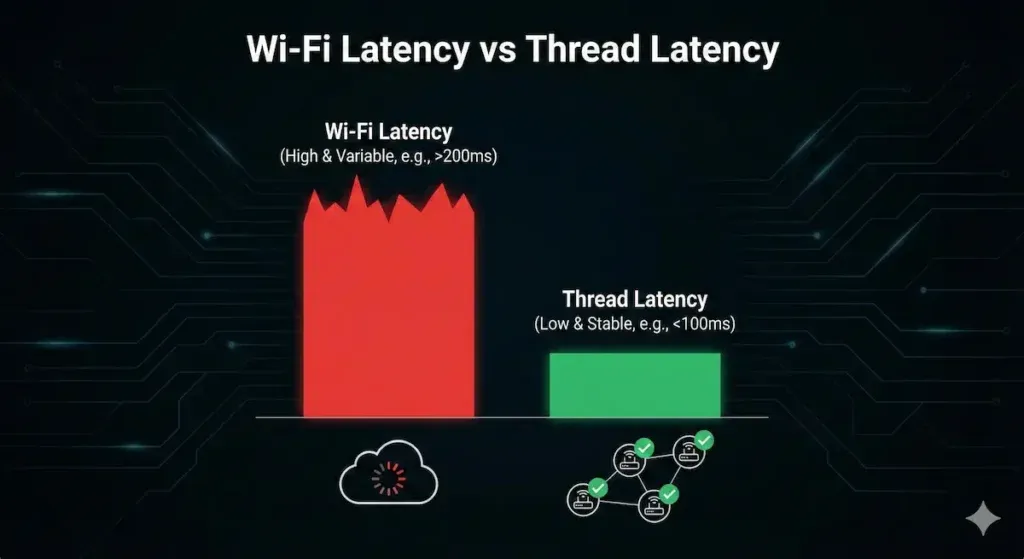
Wi-Fi vs. Thread Latency: Wi-Fi plugs often suffer from cloud round-trip delays (Jitter), whereas Thread maintains a stable, local connection.
Power Monitoring: Data for the Obsessive
Many plugs claim to monitor energy, but most provide a vague “Monthly Usage” graph that is useless for debugging. I need real-time data.
The Granularity Check
I connected a variable load (my laptop charger and a heater) to test the reporting speed.
-
Update Rate: The Eve app updates power consumption (Watts), Current (Amps), and Voltage (Volts) almost in real-time.
-
Accuracy: Comparing the app’s readout against my external multimeter, the deviation was less than 1-2%.
Why this matters to me: I use this to detect “Vampire Power” (standby power) on my development workstations. Being able to see that a device is drawing 0.5W versus 5W in sleep mode is a crucial insight for energy management. Eve provides this raw data clearly, which speaks to the quality of the internal firmware and sampling rate.
The “Matter” Standard: Future-Proofing?
The label says “Matter Support.” What does this actually mean for us?
It means Interoperability. An Eve plug used to be an Apple-ecosystem purchase, full stop. With the Matter protocol running on the nRF chip inside, the same unit can sit under Google Home, Samsung SmartThings, and Apple Home at once.
The mechanism is Matter’s multi-admin flow:
-
The device is commissioned onto the first fabric — say Apple Home, over Thread.
-
That controller issues a second set of credentials to another ecosystem, such as Google Home.
-
Result: the device holds both fabrics at once, and either platform can control it without the other’s permission.
From a software engineering standpoint, this abstraction layer is what the IoT industry has been missing for a decade. It finally decouples hardware from the platform.
UX & Stability: The “Set and Forget” Factor
The ultimate test of any embedded system is uptime. I have had this unit running for 3 weeks continuously.
-
Disconnections: 0
-
Firmware Crashes: 0
-
Reboots required: 0
Unlike Wi-Fi based relays like the [Shelly 1 Mini Gen3]—which are engineering marvels for their size but still depend on router coverage—the Eve Energy’s Thread mesh simply creates its own path. It recovers its connection to the Thread mesh automatically. This reliability is likely due to the robust Nordic Semiconductor chipset handling the stack, rather than a cheap ESP8266 clone often found in budget devices.
My Conclusion: Paying for the Protocol, Not Just the Plug
If you look at the BOM (Bill of Materials) cost alone, $40 seems high. But if you look at it as a System Stability Investment, the math changes.
-
You aren’t paying for the plastic.
-
You are paying for:
-
Thread Radio: To fix your connection issues and extend your network.
-
Privacy: All processing is local (no cloud dependency).
-
Data Precision: Reliable voltage/current logging.
-
My Take: If you are tired of debugging your own house and just want infrastructure that works, the Eve Energy is the correct engineering choice. I’m slowly replacing my critical nodes with these, not because I want to spend money, but because I value my time.