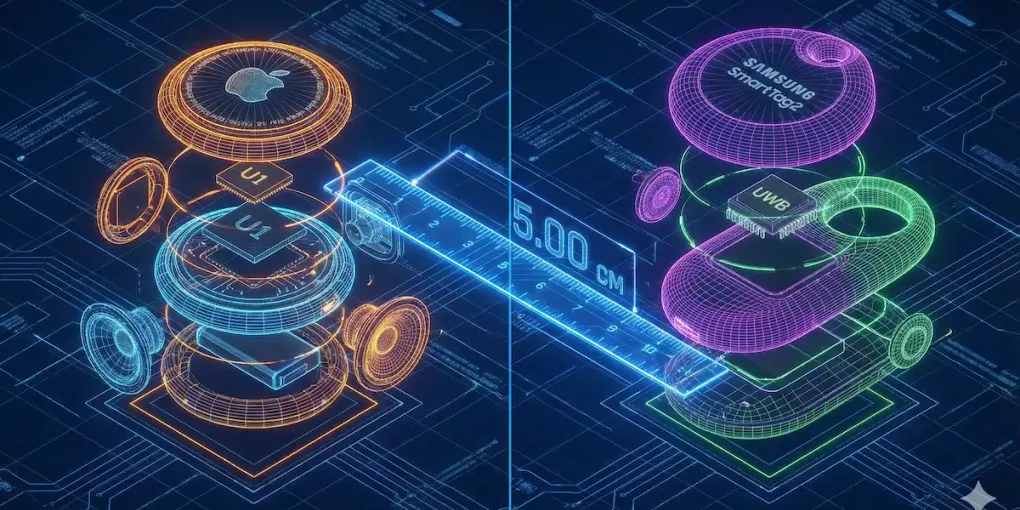
If you have ever used an older generation Bluetooth tracker, you know the frustration. The app says your keys are “Nearby,” but you are tearing apart the sofa cushions with absolutely no luck. It acts like a game of “hot or cold,” and usually, the technology is just lukewarm.
However, the introduction of the Apple AirTag and the Samsung SmartTag2 changed this landscape completely. Suddenly, our phones weren’t just guessing proximity. They started pointing a virtual arrow directly at the lost item with centimeter-level precision.
As an embedded engineer specializing in RF (Radio Frequency), I don’t just look at the white plastic casing. I look at the physics underneath. Today we are going to dive into how Ultra-Wideband (UWB) technology turns your smartphone into a precision radar and why it is vastly superior to the older Bluetooth methods.
Why Bluetooth RSSI Is Just a Guessing Game
To understand why UWB is superior, we first have to understand why Bluetooth Low Energy (BLE) often fails at precise location tracking. Most legacy trackers rely on a metric called RSSI, or Received Signal Strength Indicator.
The theory is simple. The stronger the signal, the closer the device must be. But in the real world of RF engineering, relying on RSSI is fundamentally just guessing. It is not measuring.
RSSI is incredibly volatile. If you put a thick leather bag, a human body, or a concrete wall between your phone and the tag, the signal strength drops significantly. The tracker hasn’t moved further away, but the RSSI value suggests it has. The signal also creates what we call a “multipath” effect. Radio waves bounce off walls and floors, arriving at the receiver at different times and confusing the signal strength reading.
For an engineer, RSSI is a useful diagnostic tool, but it is a terrible ruler for measuring distance.
UWB and Time of Flight Changes Everything
Ultra-Wideband technology does not care about signal strength. It cares about time.
UWB uses a method called Time of Flight (ToF). The concept is surprisingly simple but difficult to implement. The chip measures the exact time it takes for a radio pulse to travel from the tag to your phone and back.
Since radio waves travel at the speed of light ($c \approx 3 \times 10^8$ m/s), we can calculate the distance ($d$) using a fundamental physics formula.
$$d = \frac{c \times t}{2}$$
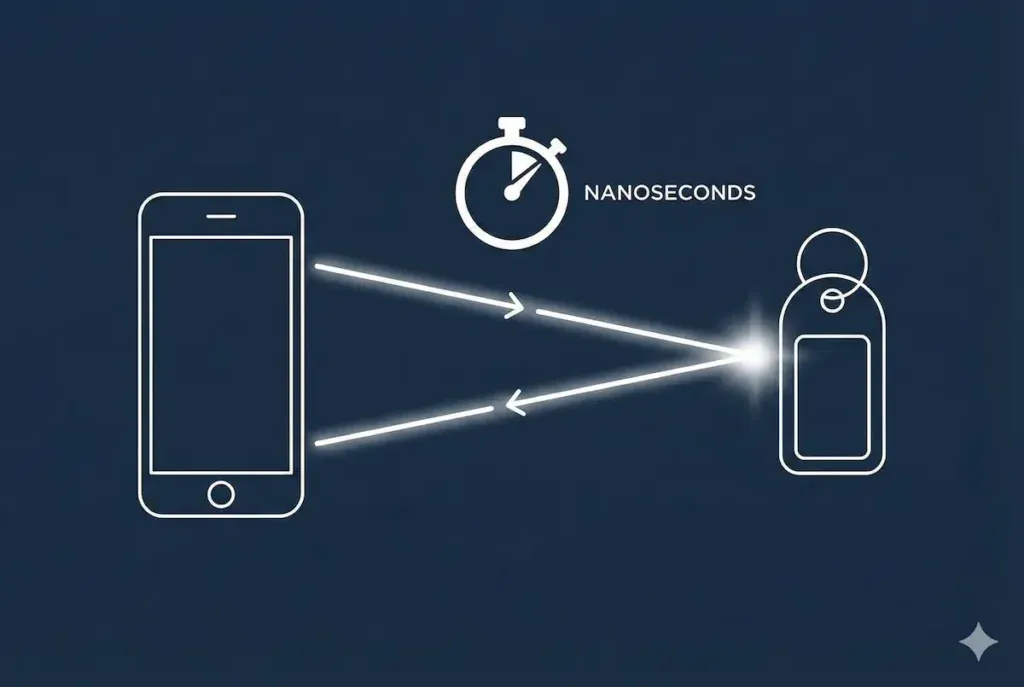
Unlike BLE RSSI, UWB measures the physical time it takes for light to travel.
Because UWB uses extremely short pulses that last only nanoseconds, it is incredibly resistant to interference. It cuts through the noise. When your phone says the tag is 1.5 meters away, it isn’t guessing based on signal loudness. It is a physical measurement derived from the speed of light. It is a digital ruler.
If you are fascinated by how RF signals can be used to detect presence (not just distance), you should definitely read my teardown of the Teardown: Aqara FP2 mmWave Sensor and the Engineering Behind True Presence, which uses similar radar principles.
How the Arrow Knows Where to Point
Knowing the distance is useful, but it does not help if you don’t know the direction. This is where the magic of the “Precision Finding” UI comes in. Whether it is the green arrow on the iPhone or the directional UI on the Galaxy, this feature is the result of complex antenna mathematics called PDoA, or Phase Difference of Arrival.
This is not just a fancy graphic overlay. It is a visual representation of trigonometry happening in real-time.
To calculate an angle, your receiver (the smartphone) needs at least two UWB antennas. When the SmartTag or AirTag emits a blink, the radio wave hits one antenna slightly before it hits the other because the antennas are physically separated by a small distance on the phone’s circuit board.
This tiny delay creates a phase difference between the received signals. By measuring this phase shift, the RF chipset calculates the Angle of Arrival (AoA). Without highly sophisticated RF antenna design and isolation on the phone’s PCB, this triangulation would be impossible.
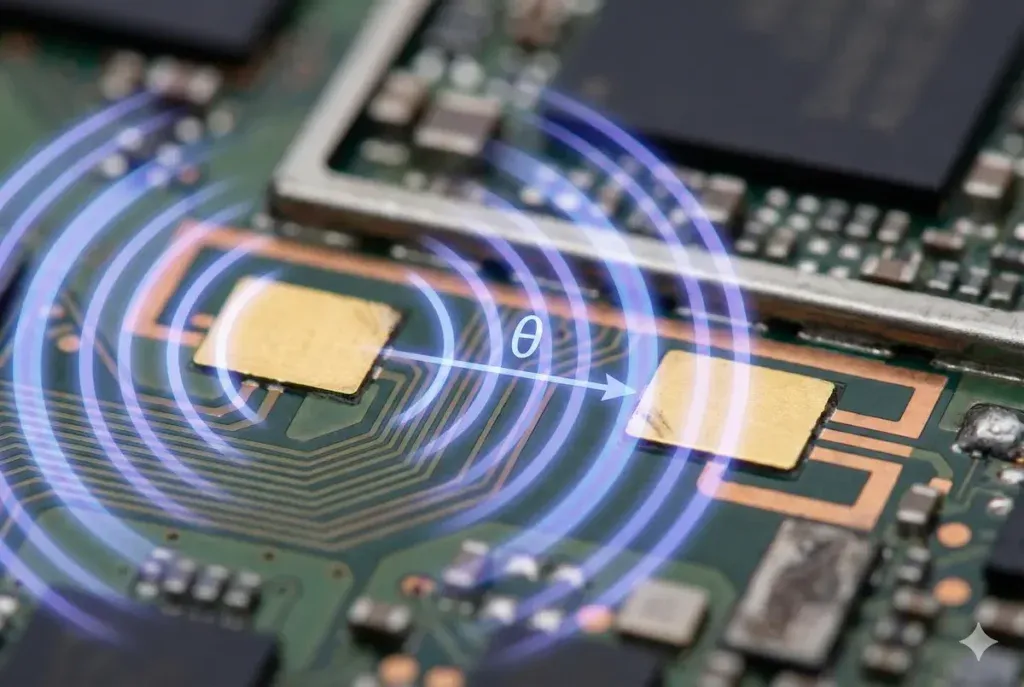
Two antennas receive the signal at slightly different times, allowing the processor to calculate the angle ($\theta$).
The Reality of Ecosystem Lock-in
Technically, UWB is standardized under the FiRa Consortium. In a perfect engineering world, a Samsung phone should be able to calculate the location of an AirTag, and an iPhone should be able to track a SmartTag2. The physics are identical.
However, the reality we face in 2026 is a business policy issue rather than an engineering limitation.
Apple uses its proprietary U-series chips, while Samsung utilizes industry-standard chips from manufacturers like NXP. Both companies encrypt their data payloads. This means that while the RF mechanics are nearly identical in performance, the networks are walled gardens.
-
Apple Find My Network: Dominant in Western markets with high iPhone density.
-
Samsung SmartThings Find: Massive coverage globally, especially in Asia and Europe.
It is worth noting that as of 2026, the cross-platform “Unwanted Tracking” standard is fully active. This means your Android phone will warn you if an unknown AirTag is following you (and vice versa for iPhone users), but you still cannot use an Android phone to find your lost AirTag with precision. Safety is shared, but utility is locked.
Which RF Masterpiece Should You Choose?
From a pure hardware engineering perspective, both the AirTag and SmartTag2 are masterpieces. They successfully miniaturized UWB radar technology—which used to require bulky industrial equipment—into a coin-sized device that runs for a year on a single battery.
Your choice ultimately depends on the phone in your pocket.
If you use an iPhone, you are locked to the AirTag for that seamless U1/U2 chip integration. If you use a Galaxy, the SmartTag2 is your best option for UWB precision.
The Bottom Line
Do not trust RSSI for finding your keys. Trust the speed of light. Whether you choose Apple or Samsung, ensure you are using a UWB-enabled tag. As engineers, we prefer measuring over guessing every single time.
Enjoyed this engineering face-off? Check out another hardware showdown in my comparison of Aqara U200 vs SwitchBot Lock Pro – High Tech or Heavy Duty?, where I analyze high-tech features against heavy-duty mechanics.
Author’s Note This post analyses the underlying RF physics of UWB technology. Specific implementations by Apple or Samsung may vary with firmware updates.