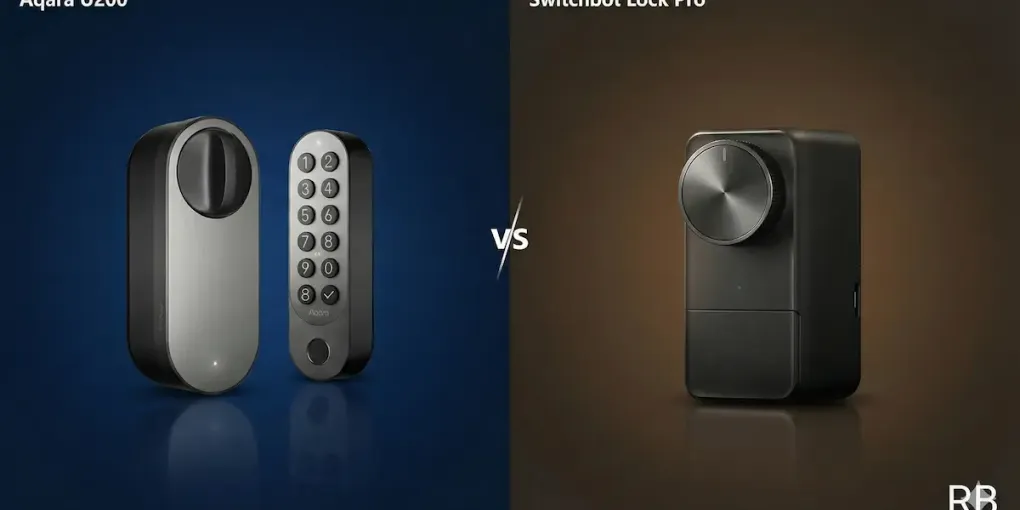
Welcome back to ReverseToBuild.
It has been over a year since the release of the Aqara U200 and SwitchBot Lock Pro. By late 2025, countless firmware updates have stabilized the Matter protocol, making these devices true daily drivers rather than just beta tests for early adopters.
We previously tore down the [Aqara U200] and analyzed the mechanical geartrain of the [SwitchBot Lock Pro]. Individually, they are excellent products. But for an engineer, “excellent” isn’t a useful metric—we need to talk about trade-offs, efficiency, and failure points.
Today, with long-term reliability data in hand, we pit them against each other to see which one has truly survived the test of time.
Let’s look at the data.
Disclaimer: This analysis is based on engineering specifications and long-term usage tests. ReverseToBuild has not received any financial compensation from Aqara or SwitchBot for this comparison.
Table of Contents
- Round 1 - The Power Systems
- Round 2 - Connectivity & Matter
- Round 3 - Installation & Compatibility
- Final Verdict - Which One Should You Buy?
Round 1 - The Power Systems
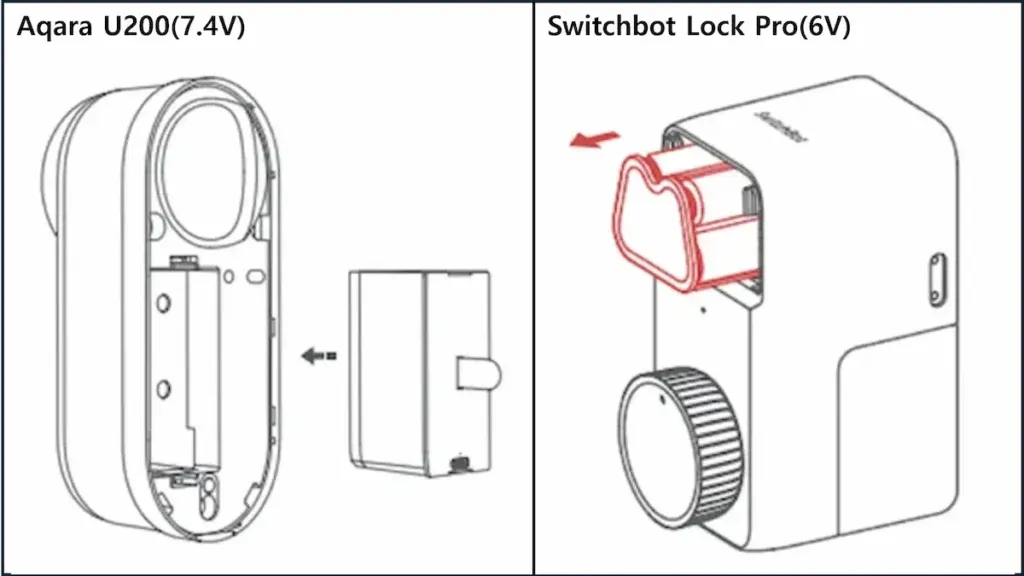
Figure 1: Power Architecture Comparison. The Aqara U200 (Left) relies on a high-voltage 7.4V rechargeable pack, while the SwitchBot Lock Pro (Right) utilizes a standard 6V (4x AA) cartridge system.
High Voltage Li-Ion vs High Gear Reduction
The most distinct engineering difference between these two lies in how they generate torque. Both claim roughly 20kgf·cm of torque, but they achieve it in fundamentally different ways.
Aqara U200 - The Voltage King
Aqara uses a rechargeable 7.4V Li-Ion battery pack. From a motor control perspective, this higher voltage allows for lower current draw to achieve the same power output, or conversely, significantly higher peak power during “break-away” (the moment the motor starts moving a sticky deadbolt).
-
The Feel: It is snappy. The response time from “command” to “movement” is immediate because the voltage headroom allows the motor to ramp up RPM instantly.
-
The Downside: When it dies, you have downtime. You must remove the pack to charge it (unless you wire it), leaving your door “dumb” for a few hours.
SwitchBot Lock Pro - The Gear Master
SwitchBot stuck with 4x AA batteries, providing a nominal 6V (dropping to ~4.8V under load as they deplete). To match Aqara’s torque with less voltage, SwitchBot relies on a massive gear reduction ratio.
-
The Engineering: By stepping down the motor speed significantly, they multiply the torque. This makes the lock feel “unstoppable.” It doesn’t snap open; it grinds open with authority.
-
The Upside: Instant recovery. When the batteries die, you swap them in 10 seconds. No charging downtime.
Winner - Draw
This is purely a lifestyle choice.
-
Choose Aqara if you want the high-performance feel and eco-friendly rechargeability.
-
Choose SwitchBot if you treat your lock like mission-critical infrastructure that cannot tolerate charging downtime.
Round 2 - Connectivity & Matter
Native Thread vs Bridged Wi-Fi
Here is where the software architecture diverges. Both support Matter, the standard for smart home interoperability, but the topology is different.
Aqara U200 - Native Matter over Thread
The U200 speaks Thread directly. It doesn’t need a proprietary Aqara hub if you already have a Thread Border Router (like an Apple TV 4K or HomePod).
-
Latency: Extremely low. The command goes from your phone $\rightarrow$ Border Router $\rightarrow$ Lock (via IPv6 over Thread). It’s efficient and keeps the 2.4GHz spectrum clean.
-
Future Proofing: This is the “purest” implementation of Matter. By late 2025, Thread networks have become significantly more stable than at launch.
SwitchBot Lock Pro - Matter over Bridge
SwitchBot uses a “Bridge” method. The lock uses a proprietary Bluetooth/sub-GHz protocol to talk to the SwitchBot Hub 2. The Hub 2 then speaks Matter over Wi-Fi to your home controller.
-
The Bottleneck: You are introducing an extra hop. Controller $\rightarrow$ Wi-Fi $\rightarrow$ Hub $\rightarrow$ Bluetooth $\rightarrow$ Lock. Theoretically, this introduces latency.
-
The Range Advantage: However, Wi-Fi + Bluetooth usually beats Thread on range penetration in large concrete homes or environments with thick walls.
Winner - Aqara U200
For an embedded engineer, the native Thread implementation is cleaner. It reduces points of failure (no external bridge required) and reduces network congestion.
Round 3 - Installation & Compatibility
Precision Clamping vs The “Universal” Finger
You can have the best firmware in the world, but if the mechanical coupling slips, the device fails.
Aqara U200 - The Clamp
Aqara uses a set-screw clamping mechanism that attaches directly to the tailpiece or the knob. It is rigid and solid.
- The Issue: It demands standard geometry. If your thumb-turn is slightly tapered, too thick, or oddly shaped, the clamp may struggle to get a concentric grip. Misalignment here leads to motor strain and battery drain.
SwitchBot Lock Pro - The Universal Adapter
SwitchBot’s mechanical engineering team deserves credit here. They utilize a spring-loaded “Universal Finger” adapter. It doesn’t clamp rigidly; it adjusts to grab the thumb-turn regardless of its offset or shape.
- The Genius: It accommodates “wobble.” Retrofit locks rarely align perfectly with the deadbolt axis. The SwitchBot adapter allows for a degree of tolerance (slop) that prevents the motor from binding.
Winner - SwitchBot Lock Pro
SwitchBot wins on pragmatism. It fits 99% of doors, even the weird ones found in older rentals.
Final Verdict - Which One Should You Buy?
As engineers, we don’t do “one size fits all.” Here is your decision matrix for 2025.
Buy the Aqara U200 if…
-
You are an Apple Home/Home Assistant Power User. You have a robust Thread network and want to utilize it.
-
You value speed. You want that instant, snappy unlock response.
-
You have a standard door. Your deadbolt is modern, smooth, and standard.
-
You hate buying batteries. You prefer recharging a Li-Ion pack every 6 months.
Buy the SwitchBot Lock Pro if…
-
You have a “Weird” Door. Your thumb-turn is old, stiff, or non-standard. The universal adapter will save you headaches.
-
You prioritize 100% Uptime. You want to swap AA batteries and be back online in seconds, rather than waiting for a recharge.
-
You are a Renter. The mounting system is slightly more forgiving and easier to remove without a trace.
-
You already own a SwitchBot Hub. It integrates seamlessly with their ecosystem.
Engineering Spec Comparison
| Feature | Aqara Smart Lock U200 | SwitchBot Lock Pro |
|---|---|---|
| Power Source | 7.4V Li-Ion Rechargeable | 4x AA Batteries (6V) |
| Connectivity | Native Matter over Thread | Matter over Wi-Fi Bridge (Hub 2) |
| Torque | ~20kgf·cm (High Voltage) | ~20kgf·cm (High Gear Reduction) |
| Mechanical Fit | Precision Clamp (Requires Standard) | Universal Finger (High Tolerance) |
| Latency | Low (Direct Thread) | Medium (Bridge Hop) |
| Best For | Tech Enthusiasts / Optimizers | Renters / Pragmatists |
For more teardowns and embedded system analysis, make sure to subscribe to the ReverseToBuild RSS feed.