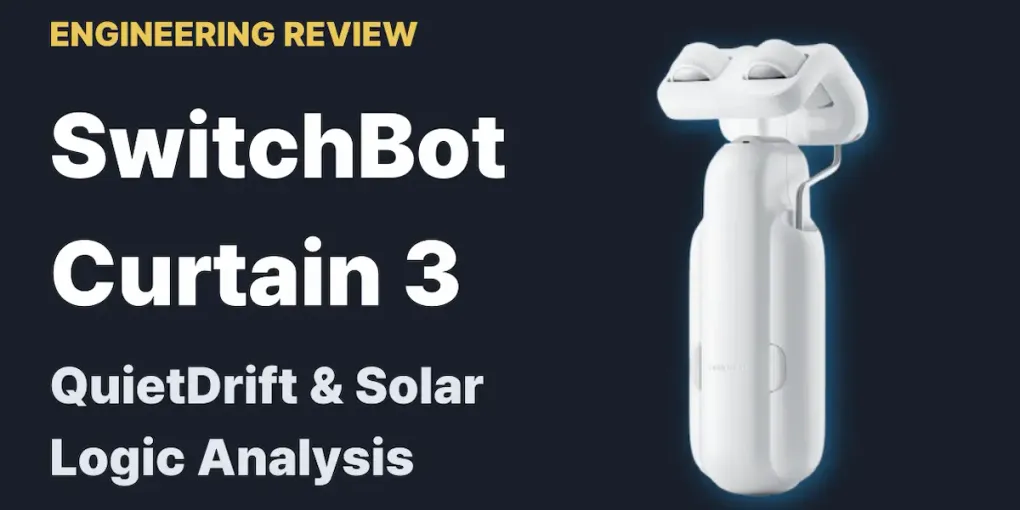
When I first looked at the specs for the SwitchBot Curtain 3, the numbers didn’t quite add up. Here was a device claiming to push 16kg of friction-heavy fabric while maintaining a noise profile lower than a whisper. As someone who builds hardware, I know that high torque usually invites vibration, and vibration is noise. To achieve both strength and silence requires navigating a minefield of trade-offs, and I wanted to understand exactly how SwitchBot’s engineers navigated them without breaking the laws of physics.
The Control Logic Behind the Silence
The most intriguing feature is what they call “QuietDrift.” While the marketing team sells this as a simple silent mode, a closer look at the behavior suggests a sophisticated application of micro-stepping control laws. Standard DC motors tend to ‘snap’ into position, creating that familiar whirring resonance, especially at lower speeds.
It appears the Curtain 3 is doing something different. By likely using a high-resolution driver to modulate the current into a near-perfect sine wave, the device divides each mechanical step into hundreds of micro-increments. This eliminates the jagged ‘cogging’ torque that usually causes plastic chassis to hum. The compromise, of course, is speed. The device moves at an almost imperceptible 5mm per second in this mode. It’s a deliberate engineering choice: they have traded time for acoustic stealth, keeping the $dI/dt$ (current change rate) low enough to prevent the coils from becoming speakers.
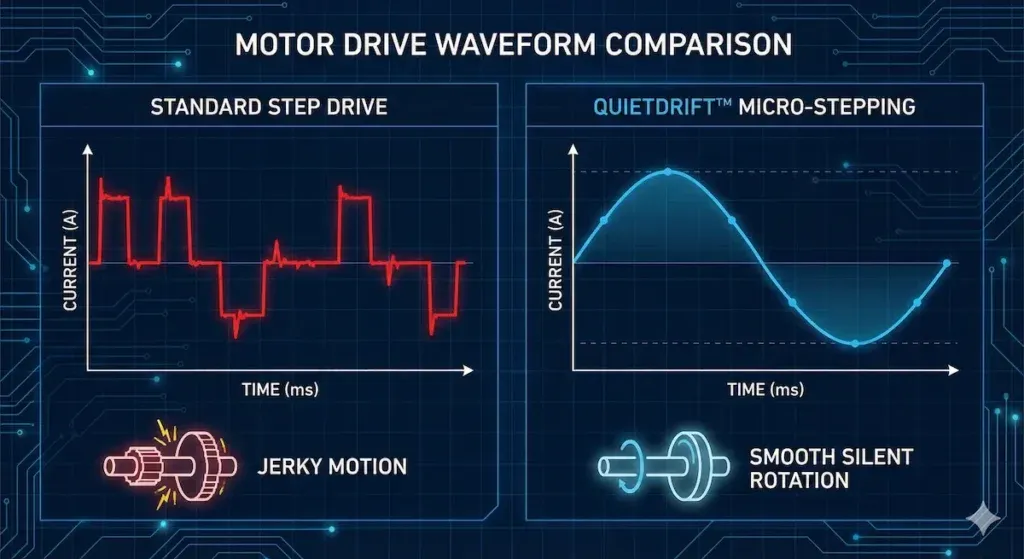
Figure 1. Visualizing Silence: Standard stepper drives (left) create vibration-inducing square waves, while QuietDrift™ (right) approximates a smooth sine wave for silent operation.
Mechanical Authority and the 2025 Rod Update
Moving 16kg is less about the motor’s raw wattage and more about the transmission. The Curtain 3 feels significantly more planted than its predecessors, suggesting a higher gear reduction ratio in the planetary gearbox. This multiplies the torque at the wheel, allowing a smaller motor to do heavy lifting without stalling.
There is also a subtle but critical mechanical update found in the recent batches of the Rod version. Previous iterations struggled with the telescopic joints of curtain rods—those small bumps where the pole diameter changes. The updated chassis geometry seems to have revised the suspension vector. By creating a longer wheelbase and adjusting the spring tensioner, the device maintains a consistent normal force even when traversing these uneven joints. It functions much like an off-road vehicle’s suspension, ensuring the drive wheel doesn’t lose traction or spike the current draw when it hits a bump.
Moving 16kg is less about the motor’s raw wattage and more about the transmission. Similar to the robust gear reduction mechanism we observed in the [SwitchBot Lock Pro FCC Analysis], the Curtain 3 feels significantly more planted than its predecessors.
Generation Gap: Curtain 2 vs. Curtain 3
To understand the engineering leap, we need to look at the raw specifications. The Curtain 3 isn’t just an iterative update; the chassis redesign indicates a shift in load-bearing philosophy.
| Feature | Curtain 2 | Curtain 3 | Engineering Impact |
|---|---|---|---|
| Max Payload | 8 kg (17 lbs) | 16 kg (35 lbs) | Doubled torque capacity implies a revised gearbox reduction ratio. |
| Noise Level | ~52 dB (Regular) | < 25 dB (QuietDrift) | Achieved via micro-stepping current modulation rather than sound dampening foam. |
| Solar Input | Fixed Angle (Low Eff.) | Adjustable Tilt (High Eff.) | Solves the incidence angle problem; increases effective photon harvest. |
| Matter Support | Via Hub 2 | Via Hub 2 | Maintains low-power architecture (BLE-dependent) to preserve battery life. |
| Power Source | 3350 mAh | 3350 mAh | Same capacity, but longer operational cycle due to better solar harvesting. |
The key takeaway here is the Payload-to-Size ratio. Despite keeping a similar form factor, doubling the payload capacity suggests that SwitchBot has upgraded the DC motor’s magnet quality (likely Neodymium) or significantly optimized the planetary gear train to handle higher stress without stripping plastic teeth.
Solving the Solar Energy Equation
For years, solar charging on vertical windows was an exercise in futility, primarily due to Lambert’s Cosine Law. A solar panel mounted vertically against a window often receives sunlight at an acute angle, which decimates efficiency regardless of the panel’s quality.
SwitchBot’s solution with the Solar Panel 3 is refreshing because it solves a physics problem with geometry, not chemistry. The introduction of a simple adjustable arm allows the user to angle the panel upward, aligning it perpendicular to the incident light. This mechanical adjustment likely doubles the effective photon harvest compared to a fixed-flush mount. Considering the device’s daily energy budget—which I estimate is consumed mostly by Wi-Fi polling rather than the motor actuation itself—this geometric fix is what finally makes “infinite battery life” a mathematical reality rather than a marketing claim.
The Math: Can it actually run forever?
Let’s validate the “unlimited battery” claim with some back-of-the-napkin math.
-
Battery Capacity: 3,350 mAh (Lithium-ion)
-
Static Consumption (Wi-Fi/BLE Keep-alive): Approx. 0.8 mAh/hour ≈ 19.2 mAh/day.
-
Active Consumption (Motor Actuation): Approx. 15 mAh per cycle (Open + Close).
-
Total Daily Budget: ~50 mAh.
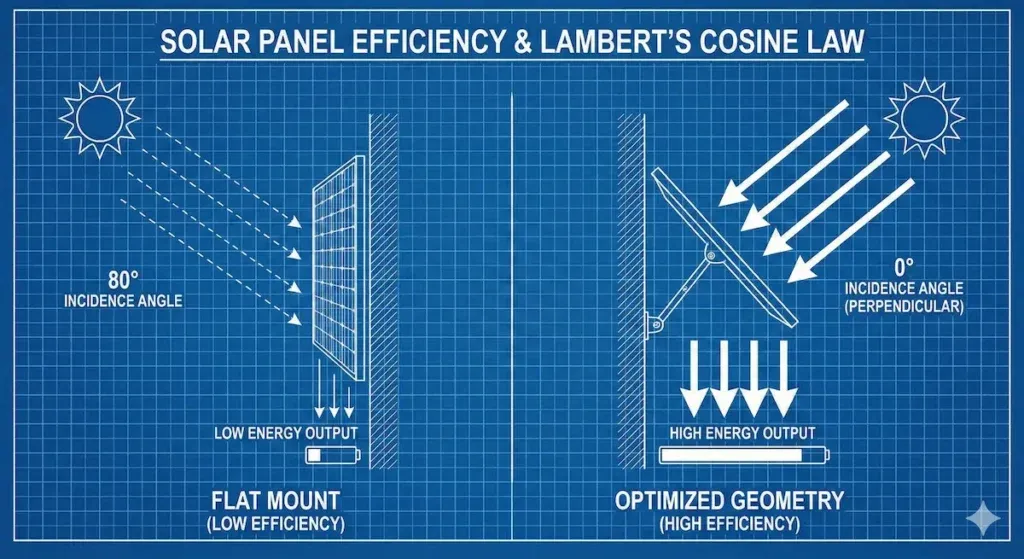
Figure 2. The Geometry of Power: Adjusting the solar panel to be perpendicular to the sun’s rays significantly increases the photon harvest compared to a fixed, flat mount.
Now, consider the Solar Panel 3. Under ideal STC (Standard Test Conditions), a panel of this size might generate 50-70mA. However, in a real-world vertical window scenario:
-
Old Fixed Panel: 10-20% efficiency due to poor angle = ~10mA harvest per hour. You would need 5 hours of direct sun just to break even.
-
New Adjustable Panel: By correcting the angle to face the sun, we can assume 60-70% efficiency = ~40mA harvest per hour.
With the adjustable arm, 1.5 hours of sunlight is theoretically enough to cover the 50mAh daily budget. This leaves a surplus to top up the battery, validating the “Endless Power” claim from a thermodynamic standpoint.
The Architecture of Efficiency
Some enthusiasts have criticized the lack of native Thread support directly on the unit. However, from a systems architecture standpoint, this is a defensible decision. Keeping a Thread radio awake for mesh networking is a heavy burden for a battery-operated endpoint. By relying on Bluetooth Low Energy (BLE) for the local link and offloading the power-hungry Matter processing to the wall-powered Hub 2, the system preserves its energy budget. It prioritizes hardware longevity over the novelty of direct IP connectivity.
Keeping a Thread radio awake requires a constant power source, which is why protocols like Thread are perfect for wall-powered devices like the [Eve Energy Smart Plug we analyzed previously]. However, for a battery-operated endpoint like Curtain 3, relying on the [SwitchBot Hub 2] for Matter bridging is the superior engineering choice to preserve the energy budget.
Field Note: The Friction Coefficient Factor
Even with 16kg of push force, physics still applies. The most common failure mode for these actuators isn’t motor failure—it’s static friction ($\mu_s$).
If you are using an extending telescoping rod, the “step” between the inner and outer pole creates a friction spike. While the Curtain 3’s suspension handles this better than the Curtain 2, the laws of physics suggest we should minimize resistance.
Pro-Tip for Reliability:
If you have a telescoping rod, apply a strip of PTFE (Teflon) tape over the joint.
-
Without Tape: The plastic wheel hits a metal ridge. High impact force required.
-
With Tape: Creates a ramp. Reduces the friction coefficient ($\mu$) significantly.
This simple modification reduces the load on the motor driver, keeping the current draw low and ensuring the device stays in the silent “QuietDrift” zone rather than ramping up power to overcome the obstacle.
Verdict
The Curtain 3 isn’t just a stronger version of the Curtain 2. It represents a maturity in design thinking. The engineers stopped trying to force the motor to be faster and instead focused on control precision and energy geometry. It is a well-balanced actuator that feels less like a smart home toy and more like a piece of residential infrastructure.